
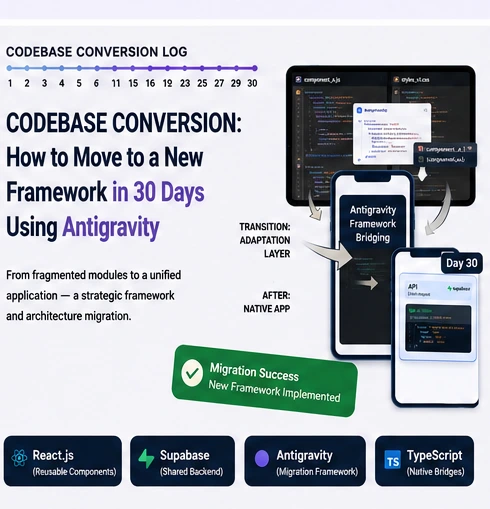
Our team recently faced a tough decision. We had a large web application that was working fine for users, but the codebase was becoming too old and messy. Making small updates started taking days instead of hours, and it was hard to train new developers on the old system.
We knew we had to move our entire frontend code to a modern framework. However, a traditional rewrite from scratch would take at least 5 to 6 months, and we did not have that much time.
We set a strict deadline to finish the whole conversion in exactly 30 days. To hit this target, we used a specialized code migration tool called Antigravity to do the heavy work for us.
The Strategy: Automate the Structure
The biggest mistake teams make during a migration is trashing everything and starting over completely. Our strategy was different: we kept the backend system exactly the same and only converted the existing frontend structures.
We used Antigravity to scan our old codebase files and translate them into clean, basic components for our new framework. Instead of spending weeks manually rewriting buttons, forms, and page layouts, the tool generated the foundational code instantly. This allowed our engineering team to focus entirely on testing and fixing the application logic.
The 30-Day Transition Plan
To make sure we did not miss anything, we broke the month down into three clear phases:
Phase 1: Auditing and Project Setup (Week 1)
We spent the first week mapping out every single screen, user flow, and business rule in the old application. We also set up the new project environment. No actual coding or conversion started until we fully understood how the old pieces connected.
Phase 2: Rapid Conversion and Coding (Weeks 2–3)
This was the main building phase. We ran our old files through Antigravity to generate the new component layouts. Our engineers then stepped in to manually wire up the core features:
Checkout pages and input forms
Main navigation and menus
User login and access permissions
Live backend database connections
Phase 3: Testing and Final Launch (Week 4)
The final week was dedicated to double-checking the new codebase. We ran manual tests on all user paths, optimized the app loading speeds, and made sure no business logic was lost before moving the users to the new framework.
The Final Results
We completed the entire frontend migration right on Day 30 without any delays.
The application now runs on a fast, modern, and clean codebase.
New developers can read the code and build features much faster.
The backend database was left untouched, so the launch was completely safe.
A complex framework rewrite that usually takes months was finished in just 30 days.
What We Learned
1. Never Skip the Initial Review
Spending the first week just studying the old setup saved us from massive bugs later. You must find the hidden features that people forgot existed before you start converting code.
2. Tools Handle Speed, Humans Handle Decisions
Migration tools like Antigravity are perfect for fast, repetitive structural translation. They save you hundreds of hours of typing. However, automation does not understand your specific business goals, so you still need real engineers to check every line.
3. Keep the Moving Parts Low
By leaving our backend infrastructure completely alone, we reduced our risks to zero. Change only what you absolutely have to change, and your project will launch much faster.